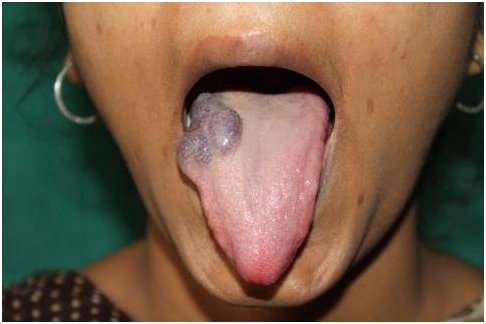
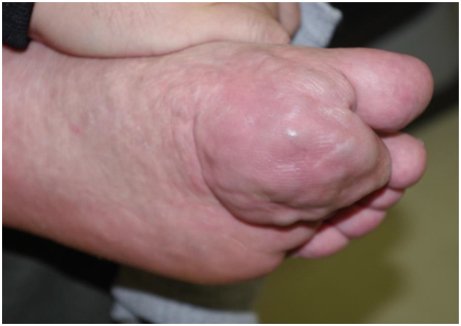
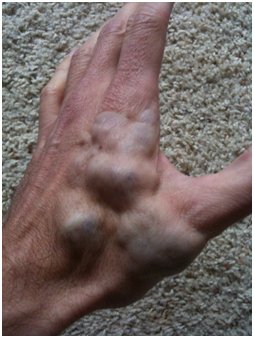
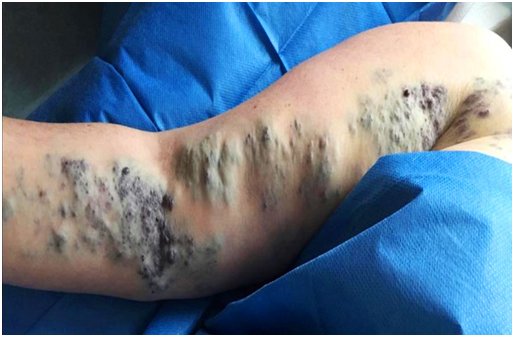
Vascular malformations are non-cancerous growths made up of a tangle of one or more types of blood vessels and can be thought of as a kind of birthmark. Most vascular malformations are present at birth (congenital) and occur by chance (sporadic) similar to a birthmark. Although, there are a few types that can be inherited as a family trait.
Some vascular malformations may be very noticeable, slightly noticeable or not noticeable at birth. Vascular malformations will grow with time. Some vascular malformations can become prominent suddenly due to illness or some may become more prominent gradually during periods of growth such as adolescence or pregnancy.
Vascular malformations can be small, focused in one area of the body, or they can be large, involving several areas of the body. Vascular malformations may range from asymptomatic to seriously symptomatic. Serious symptoms include difficulty walking or moving, pain, swelling, blood clots, muscle weakness, and, if it is located in the head and face, problems with seeing, breathing, or swallowing.
Vascular malformations that are symptomatic may require treatment. Both diagnosis and treatment will depend on your specific type of vascular malformation. There are many different types of vascular malformations that are named based on the vessels that are involved. The four main vessels in our bodies include: lymphatics, veins, arteries, and capillaries.
Treatment of Hemangioma:
Varies from simple Compression garment, Sclerotherapy, Surgery, Embolization. Some rare types require multiple sessions of several treatments spread across years.